


Choosing football matches to bet on should not begin with a hunch, a favourite team or the biggest fixture of the day.
A better approach is to use statistics to reduce a long list of fixtures into a smaller group of genuine betting candidates.
That does not mean statistics can guarantee a winning bet. Football is unpredictable - and even selections supported by strong data can lose. What statistics can do is help you make more consistent decisions, avoid weaker opportunities and identify matches where several indicators support a particular market.
This guide explains how to analyse football matches for betting from start to finish. It covers how to narrow down the day’s fixtures, compare the most relevant statistics, assess the available odds and build a final shortlist.
We’ll also show how the information displayed on Goals Guru’s Daily Qualifier Cards can help you complete each stage without searching across multiple statistics websites.
How To Choose Football Matches To Bet On
A practical football betting research process can be divided into eight stages:
- Narrow down the day’s fixtures.
- Choose an appropriate betting market.
- Compare recent form and season statistics.
- Examine home and away scoring patterns.
- Check the predicted goal totals.
- Use recent head-to-head data as supporting evidence.
- Decide whether the odds offer value.
- Build a final shortlist.
The order matters.
Many bettors begin by looking at the odds or selecting a team they expect to win. A more structured process starts with the data and only considers the price after a match has passed the initial checks.
1. Narrow Down the Day’s Fixtures
The first challenge is not finding a match to bet on - it is reducing the number of matches you need to analyse.
On a busy Saturday, there may be hundreds of fixtures across different leagues and competitions. Researching every match properly is unrealistic, so the first stage is to remove unsuitable options.
You may decide to exclude:
- Leagues with limited or unreliable statistical data.
- Friendly matches.
- Cup games with possible squad rotation.
- Matches involving teams you know very little about.
- Fixtures where there is no clear statistical angle.
- Matches with extremely short or unappealing odds.
It is usually better to understand a smaller group of leagues than to bet across dozens of unfamiliar competitions.
You can also apply basic criteria to create an initial shortlist. For example, when researching a goals bet you might look for matches involving two teams with strong scoring records. When researching a home win, you could concentrate on teams with a strong home record facing opponents with poor away form.
Goals Guru’s Daily Qualifiers complete this initial filtering for you. Instead of beginning with every match being played that day, you begin with a smaller group of fixtures that have passed our minimum data checks.
Each qualifying match is presented on its own card, with a star rating that helps you scan the wider shortlist and identify the strongest statistical candidates first.
This can significantly reduce your research time, but qualification does not mean that a match is an automatic bet. The cards provide a starting point for your own analysis and significantly shorten your research process, leaving you in control of the market and final selection.
2. Choose an Appropriate Market
The next step is to decide which betting market best suits the match.
A common mistake is to analyse a fixture without first deciding what you are looking for. The statistics that matter when considering a home win are not necessarily the same as those required for Over 2.5 Goals or Both Teams To Score.
Common football betting markets include:
- Match Result.
- Double Chance.
- Draw No Bet.
- Over / Under 2.5 Goals.
- Both Teams To Score.
- Team Goals.
- First Half Goals (FHG).
- Second Half Goals (SHG).
- Asian Handicaps.
The chosen market should match the available evidence.
For example, a strong team may be expected to win but if the Match Result odds are extremely short then one of the goals markets may be more suitable. Similarly, two inconsistent teams may be difficult to separate in the Match Result market but may both have strong scoring and conceding records.
Before continuing your analysis, write down the market you are considering. This helps you concentrate on the relevant statistics instead of being distracted by unrelated figures.
Every Daily Qualifier Card shows which markets are currently supported by the data. These may include Over 1.5 Goals, Over 2.5 Goals, Both Teams To Score, First Half Goals and Second Half Goals.
A tick does not mean that you must use that market - it tells you that the match has met the relevant criteria and that the market is worth investigating. You can then compare the Suggested Markets and choose the one that best fits both the statistics and your own betting approach.
3. Compare Recent Form and Season Statistics
Recent form shows how a team has been performing lately, while season statistics provide a larger and usually more reliable sample.
Both can be useful, but neither should be considered in isolation.
Recent Form
Recent results may reveal:
- An improvement or decline in performance.
- A change in scoring output.
- Developing defensive problems.
- A run of particularly difficult or easy opponents.
- The impact of a new manager or tactical approach.
A team that has won four of its previous five matches may appear to be in excellent form. However, those results still require context.
Ask:
- Who did they play?
- Were the matches at home or away?
- Were the performances as strong as the results?
- Did they benefit from red cards, penalties or late goals?
- Is the recent run consistent with their season-long record?
Season Statistics
Season data helps reduce the risk of overreacting to a small number of results.
Useful figures may include:
- Matches won, drawn and lost.
- Goals scored and conceded.
- Average total goals.
- Clean Sheet percentage.
- Failure to score percentage.
- Both Teams To Score percentage.
- Over 2.5 Goals percentage.
- Expected goals figures (xG), where available.
The aim is to find agreement between recent form and the broader season data.
For example, a team with strong season-long home results and good recent home performances may be a more convincing candidate than one whose entire statistical case relies on its previous two matches.
Daily Qualifier Cards separate recent form information from the wider season data. The form section shows how the teams’ latest matches have performed, while the season section provides broader home and away scoring and conceding figures.
This makes it easier to see whether a recent trend is supported by a larger sample. A particularly strong candidate may show agreement between its recent form rating, goals-per-game figure and season-long scoring patterns.
4. Examine Home and Away Scoring Patterns
Overall league statistics can be misleading because some teams perform very differently at home and away.
A team may have a strong scoring record across the season but produce most of its goals at home. Another may appear defensively reliable overall while conceding regularly in away matches.
Split the data whenever possible.
For the home team, examine:
- Home wins.
- Home goals scored.
- Home goals conceded.
- Home clean sheets.
- Home matches producing Over 2.5 Goals.
- Home Both Teams To Score results.
For the away team, examine the same figures from its away fixtures.
Imagine that a home team averages 1.90 goals scored per home match, while the away side concedes an average of 1.80 goals per away match. Those figures may support a Home Team Goals bet.
Alternatively, if both teams score regularly in the relevant home and away splits then Both Teams To Score is worth investigating.
The important point is to compare statistics that reflect the location of the upcoming match.
Daily Qualifier Cards display the home team’s home scoring and conceding averages alongside the away team’s corresponding away figures. They also show the average total goals produced in each team’s matches.
This allows you to compare the most relevant location-specific statistics without relying on potentially misleading overall averages.
5. Check the Predicted Goals
Predicted Goals can help summarise the attacking and defensive expectations for a fixture.
A basic Predicted Goals calculation may combine:
- The home team’s average goals scored at home.
- The away team’s average goals conceded away.
- The away team’s average goals scored away.
- The home team’s average goals conceded at home.
For example:
- Home team’s average goals scored at home: 1.80.
- Away team’s average goals conceded away: 1.60.
- Predicted home goals: 1.70.
Then:
- Away team’s average goals scored away: 1.20.
- Home team’s average goals conceded at home: 1.00.
- Predicted away goals: 1.10.
This would produce a combined prediction of 2.80 goals.
That figure could support an Over 2.5 Goals selection, but other factors should also be considered before making that decision.
Predicted Goals are most useful when they agree with other evidence, such as:
- High Over 2.5 Goals percentages.
- Strong scoring rates.
- Weak defensive records.
- Frequent Both Teams To Score results.
- Suitable home and away patterns.
Be cautious when the predicted figure sits close to the betting line. A prediction of 2.55 total goals is not necessarily strong evidence for Over 2.5 Goals. The greater the margin above the required line, the stronger the statistical case may be.
Each Daily Qualifier Card includes Predicted Home Goals, Predicted Away Goals and Predicted Total Goals. It also displays the Goals Guru Scorecast, providing a simple indication of how those underlying figures could translate into a final scoreline.
These forecasts should be checked against the form and season statistics shown elsewhere on the card. A predicted total above 2.50 is more convincing when the recent goal form, home and away match GPG and Suggested Market checks all point in the same direction.
The Goals Guru Scorecast takes the stats on the whole card into consideration before producing our predicted final scoreline and that's why we're "in the ballpark" a lot of the time in terms of final result, although exact final scores are very difficult to predict so we don't advise backing the Scorecast prediction in the Correct Score market - the Scorecast is simply used as a guide.
6. Use Recent H2H as Supporting Evidence
Head-to-head results are popular with bettors, but they are often given too much importance.
Previous meetings can provide context, particularly when the teams have played recently under similar circumstances. However, older results may have little relevance because of changes in:
- Managers.
- Players.
- Tactics.
- League position.
- Club ownership.
- Team quality.
- Motivation.
A match played four or five years ago should rarely influence a current betting decision and that's why we only focus on H2H results across the last 2-3 league seasons.
Use head-to-head data to support an existing case rather than create one.
For example, if current scoring statistics suggest that both teams are likely to score then recent league meetings with similar scorelines should strengthen your confidence. However, strong H2H figures should not override poor current data.
Current team performance should normally carry more weight than historical results.
The H2H indicator on a Daily Qualifier Card provides an additional piece of context. It should be considered alongside current form, season statistics and the match forecast - not treated as the deciding factor by itself.
If the current statistics support a goals market and recent meetings show a favourable pattern, the H2H information can strengthen the overall case. If the indicators disagree, it may be a reason to investigate further or leave the match off your final shortlist.
7. Check Whether the Odds Offer Value
A good prediction is not automatically a good bet.
The odds must also offer value.
Value exists when you believe the true probability of an outcome is higher than the probability implied by the bookmaker’s odds.
Decimal odds can be converted into an implied probability using this calculation:
Implied probability = 1 ÷ decimal odds × 100
For example, odds of 2.00 imply a probability of 50%.
If your research suggests that the outcome has a 58% chance of occurring, the odds may represent value. If you estimate its chance at 45%, the bet may offer poor value even if you think the outcome is possible.
Consider a team priced at 1.40 to win.
Those odds imply a probability of approximately 71.4%. You therefore need to believe the team has a better than 71.4% chance of winning before the price becomes attractive.
This is why backing the most likely winner is not always the same as placing the best bet.
You should also compare prices across bookmakers where possible. Even a small difference in odds can have a meaningful effect over a large number of bets.
Daily Qualifier Cards display the latest available best odds beside each suggested market. This lets you compare a market’s statistical suitability with the price being offered.
The strongest-rated match is not necessarily the best bet if its odds are too short. Equally, a slightly lower-rated qualifier may be more interesting if the available price appears to underestimate its chances.
The cards bring the evidence and price together, but the final judgement about value remains yours.
8. Build a Final Shortlist
Once you have reviewed the relevant statistics and checked the odds, reduce your selections again.
Your final shortlist should only contain matches that meet most or all of your criteria.
A simple checklist might include:
- The match passed the initial fixture filter.
- The chosen market fits the statistical profile.
- Recent form supports the selection.
- Season data supports the selection.
- Home and away splits are favourable.
- Predicted Goals support the market.
- H2H data does not reveal an obvious concern.
- The odds appear to offer value.
- There are no significant team news concerns (injuries / suspensions etc).
You do not need to place a bet on every match that reaches your shortlist.
Sometimes the correct decision is to make no bet at all. If the evidence is mixed, the odds are too short or important information is missing then leave the match alone.
Being selective is an important part of the process.
Within Daily Qualifiers you can add a match to your personal shortlist, select the market you are considering and enter the relevant odds. You can also keep notes explaining the reasons for and against a selection.
If you prefer multiples then qualifying matches can be grouped into a double, treble or larger accumulator. However, you should still assess every leg individually rather than adding a match simply to increase the combined odds.
How To Research a Football Bet More Effectively
A repeatable routine makes football betting research more consistent.
You could record every potential selection in a spreadsheet, Betting Tracker or journal with columns for:
- Fixture.
- Market.
- Odds.
- Recent form.
- Season statistics.
- Home and away data.
- Predicted Goals.
- Reasons for the bet.
- Reasons against the bet.
- Final decision.
- Result.
This makes it easier to review your decision-making later.
Over time, you may discover that certain leagues, markets or statistical filters work better for you than others. You may also identify recurring mistakes, such as placing too much weight on recent results or accepting odds that are too short.
Recording the reasoning behind each bet is more useful than recording wins and losses alone.
Common Mistakes When Picking Football Bets
Betting on too many matches
A large fixture list does not mean there are many strong opportunities. Quality matters more than quantity.
Using statistics without context
A team may have scored frequently because of an unusually easy schedule. Another may have poor recent results after facing several of the league’s strongest sides.
Relying on one statistic
No single figure should determine a bet. Look for several indicators pointing towards the same conclusion.
Overvaluing head-to-head records
Historical meetings can be valuable but current form, squad strength and venue-specific data are usually more relevant.
Ignoring the odds
An outcome can be likely without representing good value. The price should always form part of your final decision.
Changing markets to justify a bet
Do not keep searching for a market simply because you want to bet on a particular fixture. Start with the evidence and choose the market that fits it.
Ignoring team news
Statistics describe what has already happened. Injuries, suspensions, squad rotation and tactical changes can affect what happens next.
Treating every qualifier as a bet
A match appearing in Daily Qualifiers means it has passed the initial data filters. It does not mean that you should automatically bet on it. Use the card to conduct your own analysis, compare the supported markets and decide whether the available odds are suitable.
Example: Analysing a Daily Qualifier Card
Suppose a match appears in Daily Qualifiers with Over 2.5 Goals shown as a supported market.
Initial filtering
The fixture has already passed the minimum qualification checks and appears on the wider daily shortlist. Its Star Rating gives you an initial indication of the strength of its overall statistical profile.
Suggested Market
Over 2.5 Goals is marked as supported (✅), while the match result is less clear. You therefore concentrate your research on the goals market.
Form Stats
The card shows a strong Over 2.5 Goals Form Rating and a high recent form GPG. This indicates that the teams’ latest matches have regularly produced goals.
Season Stats
The home team averages 1.80 goals scored at home and concedes an average of 1.60 . The away team averages 1.50 goals scored away and concedes an average of 1.70.
Match Forecast
The predicted total is 3.10 goals and the Goals Guru Scorecast also suggests a result containing at least three goals (for example a 2-1 home win).
O2.5 Recent H2H
Recent H2H information supports the goals case, but it is treated as additional evidence rather than the main reason for selecting the match.
Best Odds
The best available odds are checked against the strength of the statistical case. If the price appears too short, the match can still be left off your final shortlist.
Final decision
The match is added to your personal shortlist because recent form, season data, home and away patterns, predicted goals and the Suggested Market check all supports the same conclusion.
This does not guarantee that Over 2.5 Goals will win, it means the selection has been researched using a repeatable process rather than chosen through instinct alone and this is a far more profitable long-term process.
How Daily Qualifier Cards Support Your Research
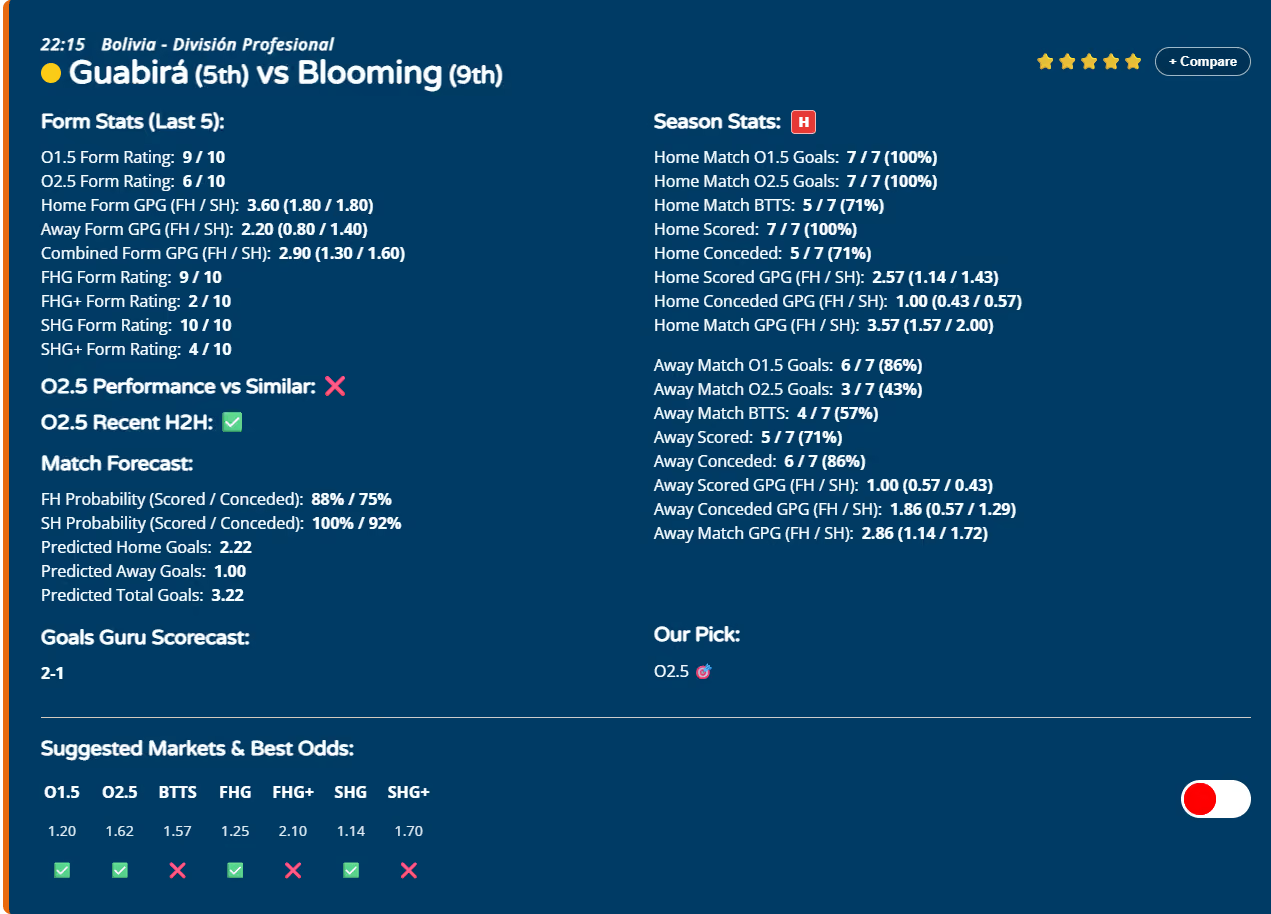
The most time-consuming part of football betting research is often finding the matches that are worth investigating in the first place.
Goals Guru’s Daily Qualifiers reduce the day’s fixtures to a wider shortlist of matches that have passed our initial data filters. Every qualifier is then presented on a card containing the information needed to conduct your own assessment.
Depending on the available data, a Daily Qualifier Card can include:
- An overall Star Rating.
- Recent goal form ratings.
- Recent goals-per-game figures.
- Home and away scoring and conceding averages.
- Home and away total match GPG.
- Recent head-to-head context.
- Predicted home, away and total goals.
- The Goals Guru Scorecast.
- Suggested betting markets.
- The latest available best odds.
You can compare the evidence, choose a suitable market and add promising matches to your own shortlist. You can also record notes and group selections into multiples when appropriate.
Daily Qualifiers are not a command to bet on every match displayed - they provide a far more efficient starting point for people who enjoy making their own selections but want data-led guidance about where to begin.
We narrow down the fixture list and organise the relevant statistics. YOU make the final decision.
Explore how Goals Guru Daily Qualifiers work.
Daily Qualifiers Guide: Key Terms & Stats Explained
Final Thoughts
Learning how to choose football matches to bet on is not about discovering a guaranteed formula - it is about becoming more selective and making decisions through a consistent research process.
Look for matches where several independent indicators support the same market. Compare recent form with season-long performance, use the correct home and away statistics, examine the predicted goals and treat recent H2H as supporting evidence. Finally, make sure the available odds justify the risk.
Goals Guru’s Daily Qualifier Cards bring these indicators together and reduce the time spent searching through hundreds of fixtures. You can review the data, compare Suggested Markets, check the available odds and build a shortlist that suits your own approach.
👉 Want a data-backed starting point for your own football betting research?
Explore Goals Guru Daily Qualifiers and build your own shortlist from the matches that pass our daily filters.
No method removes the risk from football betting. Only bet with money you can afford to lose, set clear limits and never chase losses.